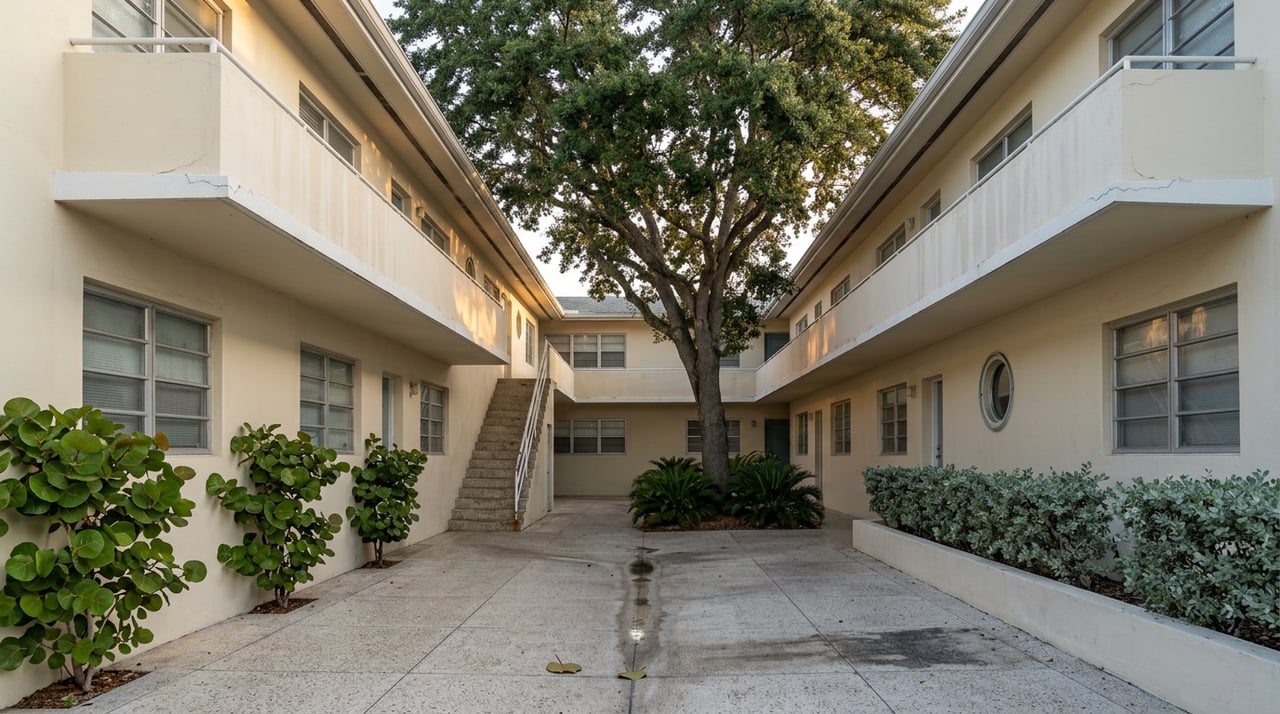
Ask someone who lives north of 60th Street to describe the neighborhood, and "quiet" usually comes up first. It's said with a kind of relief, like quiet was the whole reason for choosing this stretch of the barrier island over the noise to the south. For years that word fit. This fall, the calendar makes a different case.
Start with a number most residents have never seen written down: the Miami Beach Bandshell, the open-air amphitheater tucked into the North Shore Historic District, welcomed more than 70,000 people to over 140 concerts, festivals and community events last year. Divide it out and you get an average of roughly 500 people showing up per event, week after week, at a venue built in 1961 inside a neighborhood that still gets called sleepy. That is not a single sold-out weekend skewing the math. That is a sustained baseline of foot traffic in a part of Miami Beach that supposedly doesn't have much of one.
The Number Nobody Attaches to "Quiet"
The Bandshell has been run by the nonprofit Rhythm Foundation since 2015, and the venue itself seats 1,350 for general admission shows or up to 800 in a reserved configuration with 500 available for catered events. It sits inside Bandshell Park, which also holds a set of domino pavilions and a glass tile mandala commissioned through the city's Art in Public Places program, created by artist Kevin Arrow to mark the 50th anniversary of the Beatles' first American performance at the nearby Deauville Hotel. None of that is new information to anyone who has walked past it. What's new is the density of what's actually booked there this fall, and what that density says about who is showing up on a random Tuesday.
What's Actually Booked Between Now and Thanksgiving
The Bandshell's fall lineup reads less like a neighborhood venue filling gaps and more like a booking calendar with real demand behind it:
- September 4: Hulvey, faith-based hip-hop, part of a national tour stop
- September 7: Tayc, Afrolove and French R&B, his first Miami performance
- September 12: Mari Froes, Brazilian Popular Music
- September 27: Silvana Estrada, Latin American folk, indie and jazz
- October 4: the Florida Fellowship Super Choir, marking its 10th anniversary with gospel performances
- October 10: La Niña, part of Italian HIT Week programming
- October 15: Les Greene & The Swayzees, rock, R&B, Motown and doo-wop
- October 25: Afro Borinken Roots, an Afro-Puerto Rican heritage celebration with multiple performing groups
- November 13: Hot Mulligan, emo and pop-punk on a national fall tour
- November 19: the Aaron Lebos Quartet, a Miami-based instrumental group
Spend a minute with that list and the range is the point. Gospel choirs and pop-punk bands and Brazilian singer-songwriters don't usually share a booking calendar unless the venue has figured out that its audience isn't one demographic, it's a neighborhood. Layer in North Beach Social, the recurring third-Thursday street gathering that draws residents out for music and conversation without requiring a ticket, and the picture shifts from "occasional big show" to "something is happening here most weeks."
A New Restaurant in North Beach
Concerts alone don't rewrite a neighborhood's reputation. Kitchens do that too, and Ezio's is a new addition to North Beach. It opened this year with an Italian-inspired steak and seafood menu from the team behind Roberta's, the well-known New York restaurant group. The kitchen runs an in-house dry-aging program for beef and lamb, builds its raw bar around locally sourced seafood, and turns out dishes like cacio e pepe with winter truffle and pappardelle with braised veal alongside dry-aged steaks. The wine list runs past 110 bottles across Italy, France, Champagne and California, and the room leans into dark wood and velvet banquettes rather than the beachy casual look a lot of North Beach spots default to.
A few miles south on Indian Creek Drive, Vecinos opened from the team behind Medium Cool and Caracas Bakery. It is an all-day spot serving coffee and pastries in the morning and Spanish and Mediterranean small plates with cocktails later on. Alongside the Bandshell's fall calendar, these openings add to the activity around this part of Miami Beach.
The Daytime Version of the Same Pattern
None of this is only a nighttime story. North Beach Oceanside Park is a nine-block green space along Collins Avenue with canopy shade trees, grassy dunes, barbecue grills, picnic benches and a pair of dog runs that make it one of the most consistently used public spaces on the island. From there, the paved Beach Walk stretches the length of the neighborhood, connecting Allison Park and its life-size turtle sculptures at 62nd Street to North Shore Open Space Park at 81st Street, giving joggers, cyclists and dog walkers a continuous route that doesn't require crossing Collins.
Restaurants have historically clustered around Normandy Fountain, the traffic circle that still functions as the neighborhood's informal town square. A few blocks over, golfers at Normandy Shores Golf Club play a course with enough history that Arnold Palmer once played it himself. None of these places are new. What's changed is how many of them are getting used at the same time, on the same weekends, by people who used to have the park or the course or the fountain mostly to themselves.
How to Actually Use What's Already Here
For anyone who already lives in North Beach, the practical move is simple: stop treating the Bandshell schedule as background noise. Pick a show, walk it, and pair it with dinner at Ezio's beforehand or a coffee at one of the spots near Normandy Fountain the next morning. The North Beach Social on the third Thursday is a low-commitment way to see who else in the neighborhood has noticed the same shift, and the Beach Walk means getting from Oceanside Park to the Bandshell doesn't require a car.
None of this changes what North Beach fundamentally is. It's still the calmer half of Miami Beach, still built around MiMo architecture instead of Art Deco, still the place people choose specifically because it isn't South Beach. What's changed is the assumption that calm and empty are the same thing. A venue that pulled 70,000 people through its gates last year and a restaurant team that could have opened anywhere in Miami both made the same calculation about this neighborhood. For residents who've called it quiet for years, the calendar offers a fuller picture of what is happening here.
If you're already living here and wondering what your property looks like against a neighborhood that's clearly getting more attention, Rafael Szydlowski offers a Request a Free Home Valuation for anyone who wants a clear read on where things stand.